

Speciality Category: Medicine
Haematology & Special Coagulation Clinic
HIV Medicine
Infectious Diseases
The Infectious Diseases specialists at KEM Hospital, Pune diagnose and treat adults and children with bacterial, fungal, parasitic and other rare infections.
Our department is supported by in-house, accredited pathology, microbiology and physiology laboratories with state-of-the-art facilities, including hi-tech molecular diagnostics and a full-fledge imaging department.
Paediatric Infectious Diseases
We are a subspecialty wing of the Department of Paediatrics at KEM Hospital, Pune. We specialize in the diagnosis, treatment, research and prevention of a wide range of infectious and immunological diseases in children, under one roof.
Our team of qualified and experienced experts help children with severe, difficult, recurring,
persistent, unusual, or undiagnosed bacterial, fungal, parasitic, or other rare infections. We
work closely with your child’s paediatrician in all aspects of infections in children from birth
through the teen years. We use a multidisciplinary team approach to facilitate timely,
comprehensive, compassionate and best outcome patient care.
We provide diagnostic, management and preventive care of infectious diseases, such as:
- Childhood Fever – prolonged, recurrent, unknown, undiagnosed, difficult
- Common infectious diseases – severe and complicated community infections, such
as pneumonia, empyema, sepsis, dengue, typhoid, rickettsia, meningitis,
encephalitis, bones and joint, skin and soft tissue, liver, kidney, heart, blood and
seasonal/epidemic viral, bacterial, fungal and parasitic infections - Chronic and difficult infections – tuberculosis, COVID, atypical, HIV, STDs, congenital
(mother/parent to child), animal and insect borne infections - Special situation infections – hospital acquired infections, infections in
immunosuppressed children on steroids, biologicals, chemotherapy and transplant
recipients - Peri and post infectious disorders – Kawasaki disease, HLH, GBS, post COVID
complications such as MIS-C - Primary Immunodeficiency Disorders
We have a dedicated Immunization clinic providing up-to-date and affordable, routine and
special situation, full range vaccinations for all age groups. We follow standard, meticulous
and supervised practices for storage, administration, monitoring, documentation and follow-
up. We also provide free pre and post immunization counselling, guided by expert faculty.
We have a dedicated research department of national and international repute that conducts
trials and research projects and contributes immensely to the field of paediatrics, infectious
diseases and vaccine research.
- We educate and train postgraduate doctors in accurate diagnosis, personal care,
rational management, advanced research and effective prevention of infectious
diseases of childhood - We provide community education and awareness programs in infection control and
prevention and training for health care workers and doctors through a dedicated
Hospital Infection Control Committee team - We practise, facilitate, promote and train health care providers in antimicrobial
stewardship, antibiotic resistance awareness and rational antibiotic practises
Interventional Neurology
Medical Oncology
Nephrology (Renal)
KEM Hospital, Pune pioneered the development of specialized Nephrology in Pune in 1969, with the establishment of the first dialysis unit in Maharashtra, after Mumbai. Initially dependent on peritoneal dialysis, it was the first in the city to start haemodialysis in 1972. Kidney transplantation followed in 1991.
Today, our unit offers a complete range of investigations and treatments for kidney patients and our full-time staff is committed to patient care based on a team approach.
Facilities span acute and maintenance haemodialysis (HD); all variants of HD including CRRT and SLED; peritoneal dialysis – both intermittent (IPD) and continuous (CAPD); and extra-corporeal therapies like plasma exchange.
A particular feature is the provision of dialytic therapies in the Critical Care Units, with 16 beds equipped for point-of-care haemodialysis. These include special treatments for critical septic / shock patients, even those not in renal failure (e.g. hemoperfusion therapies with Oxiris for cytokine storm in COVID-19 or severe sepsis, plasma exchange for ACLF, charcoal hemoperfusion for poisoning, etc)
All dialysis areas are equipped with RO plants producing ultra-pure water meeting stringent EU standards.
We have an active program, which began in 1991 and was based mainly on living related donors. We were also one of the first to enter the field of deceased donor transplantation in 1997.
We offer a comprehensive paediatric nephrology service – both indoor (IPD) and outdoor (OPD) – backed up by renal replacement therapies and a much-needed specialized bladder clinic. This service has received a grant from the Indian Society of Nephrology under the auspices of the Sister Renal Program to collaborate with the Paediatric Nephrology Service of the Great Ormond Street Hospital for Children NHS Foundation Trust, UK as level C pair.
Our department performs insertion and salvage of cuffed tunnelled catheters, fibrin sheath balloon disruption, angioplasty of AV fistulae and central veins as needed.
Our research includes single centre studies in haemodialysis, acute kidney injury, and genetic and functional studies in haemolytic uremic syndrome (HUS). We have also collaborated and participated in multicentre studies nationally and internationally in maintenance haemodialysis, acute kidney injury biomarkers with the AKIN network and on genetic studies with KEM Hospital Mumbai and MPUH Nadiad.
Specific research areas in paediatric nephrology cover: renal involvement in Wilson’s Disease, ambulatory blood pressure monitoring (ABPM) in diagnosis of hypertension in children with solitary functioning kidneys, and prevalence of haematological abnormalities in distal RTA.
Recently, our department also completed participating in a Multicentric Trial: Optimal dose of Cholecalciferol Supplementation in Children with Chronic Kidney Disease – An Open Label Randomised Control Trial.
A trained Dialysis and Transplant Coordinator counsels patients to help them adopt the most suitable treatment modality (i.e. dialysis or transplantation) for their condition. She facilitates compliance with treatment, follow-up and finding ways to overcome their financial and social difficulties. An extension of this work peculiar to our Unit is the Coordinator’s HR activities, in educating, updating, and effecting continued progress in staff attitudes. These activities are very relevant in promoting a cohesive team essential for good patient care.
- OPD Clinics: Adult General Nephrology OPDs are held twice a week, and Paediatric Nephrology OPDs are held thrice a week
- Dialysis and Transplant Clinic: is held once a week, which includes counselling for potential transplants
- Bladder Clinic: Multidisciplinary care by a team of paediatric nephrologists, paediatric surgeons and urologists for people with bladder disorders. It is equipped with state-of-the-art urodynamic equipment and has dedicated OPD / counselling areas.
Services offered:- Consultation for bladder related problems of all ages (adult and paediatric)
- Consultation for urological surgeries by paediatric surgeon / urologist
- Analysis of uroflowmetry
- Diagnosis through urodynamics
- Training for Clean Intermittent Catheterisation (CIC)
- Training for bowel care
- Treatment for urogynaecological issues
- Stone Clinic: is planned for the special investigation and management of urinary tract stones, backed up by more detailed stone analysis than presently available anywhere in the city
- Preventive Nephrology: the paediatric nephrology service has conducted a School Screening Program for hypertension in adolescent children (Classes VIII and IX) in 2018 – 2019 in 4 schools in Pune District and 900 school children were screened. This is of great importance, because up to 25% of adult chronic kidney disease may arise from undiagnosed and untreated paediatric kidney disease and hypertension.
The department has an active super-speciality teaching program. It is recognized for the DNB (Nephrology) of the National Board of Examinations, as well as the FNB in Paediatric Nephrology and Fellowship Courses of the Indian Society of Paediatric Nephrology.
Neurology
The Department of Neurology at KEM hospital, Pune was founded in 1982 and has become a
referral centre in and around Pune and Maharashtra. Our team of highly specialised
neurologists have expertise in the diagnosis and treatment of neurological conditions in adults
and children, including those with complex or rare conditions.
We provide comprehensive care to patients suffering from: stroke, epilepsy, migraine, vertigo
and balance disorders, dementia and other cognitive conditions, neuropathy, movement
disorders, autoimmune neurological disorders, degenerative neurological diseases, metabolic
diseases, neuro-ophthalmology (deals with eye abnormalities), emergencies in neurology and
complex neurological problems.
Our paediatric neurologists provide care for children suffering from epilepsy, developmental
neurological diseases, autoimmune neurological disorders, neuro-infections and neurological
emergencies.
Our neurologists work with a team of doctors and specialists in other areas to determine the
most appropriate treatment option for you. This includes working closely with the Neuro Surgery
Unit, Renal Unit, Laboratory, Radiology and Sonography departments, ICU Units which provide
care to acute emergencies in neurology, a team of dedicated physiotherapists who take care of
patients needing neuro rehabilitation, and other areas, depending on your condition. Having all
this expertise collaborating together ensures that you receive comprehensive care focused on
your individual needs.
We conduct a daily OPD, which caters to the needs of outpatients suffering from neurological
disorders.
Our neurologists constantly seek new knowledge to improve diagnosis and therapies for people
with neurological disorders. They attend conferences, participate in journal clubs and webinars,
deliver academic lectures in various forums and participate in teaching programs to medical
residents who are undergoing speciality degrees.
The Department of Neurology at KEM hospital, Pune started the first super-specialty degree in
Interventional Neurology that was approved by the National Board, Delhi.
KEM Hospital’s neurologists work with neuro-radiologists who use advanced imaging
technologies and tools, including 3 Tesla Magnetic Resonance Imaging (MRI) and 128 slice
Computed Tomography machines. With the help of radiologists, we perform Trans-cranial
Doppler to determine brain death and structural abnormalities of blood vessels that are located
at the base of the brain.
Trained technicians perform EEGs (brain graphs), nerve conduction studies, EMGs, evoked
potentials of eyes and ears (VEP and AEP), eye movement abnormalities and vertigo related
studies.
We have a dedicated neurology laboratory equipped with up-to-date facilities. The
electroencephalography facility consists of state-of-the-art Nihon Kohden Video EEG machines.
Electromyography and nerve conduction studies are performed with Nicolet’s latest EMG
machine. We also provide videonystagmography (VNG) services for patients with vertigo and
balance disorders.
The Department of Neurology is equipped with a bi-plane Cath lab system for various neuro
interventional procedures, including clot removal from blocked arteries and dilation of narrow
arteries with stents.
A stroke is caused when blood flow to your brain is stopped or disrupted. A stroke is an
emergency situation and timely treatment is crucial. Early treatment can reduce brain damage
and other complications.
We treat a large number of stroke patients, for whom we have an acute stroke care unit, which
is responsible for identifying and administering clot dissolving drugs to patients who reach us
within the appropriate time. A sizeable number of patients who fulfil the criteria, especially those
that are within 4.5 hours of the first stroke symptoms (benefits are maximum within 3 hours of
the first symptoms), receive standard thrombolytic therapy (clot dissolving treatment).
The Stroke Unit consists of a comprehensive team of emergency medicine physicians,
neurologists, interventional neurologists, radiologists, general medicine residents, trained staff
nurses and radiology technicians.
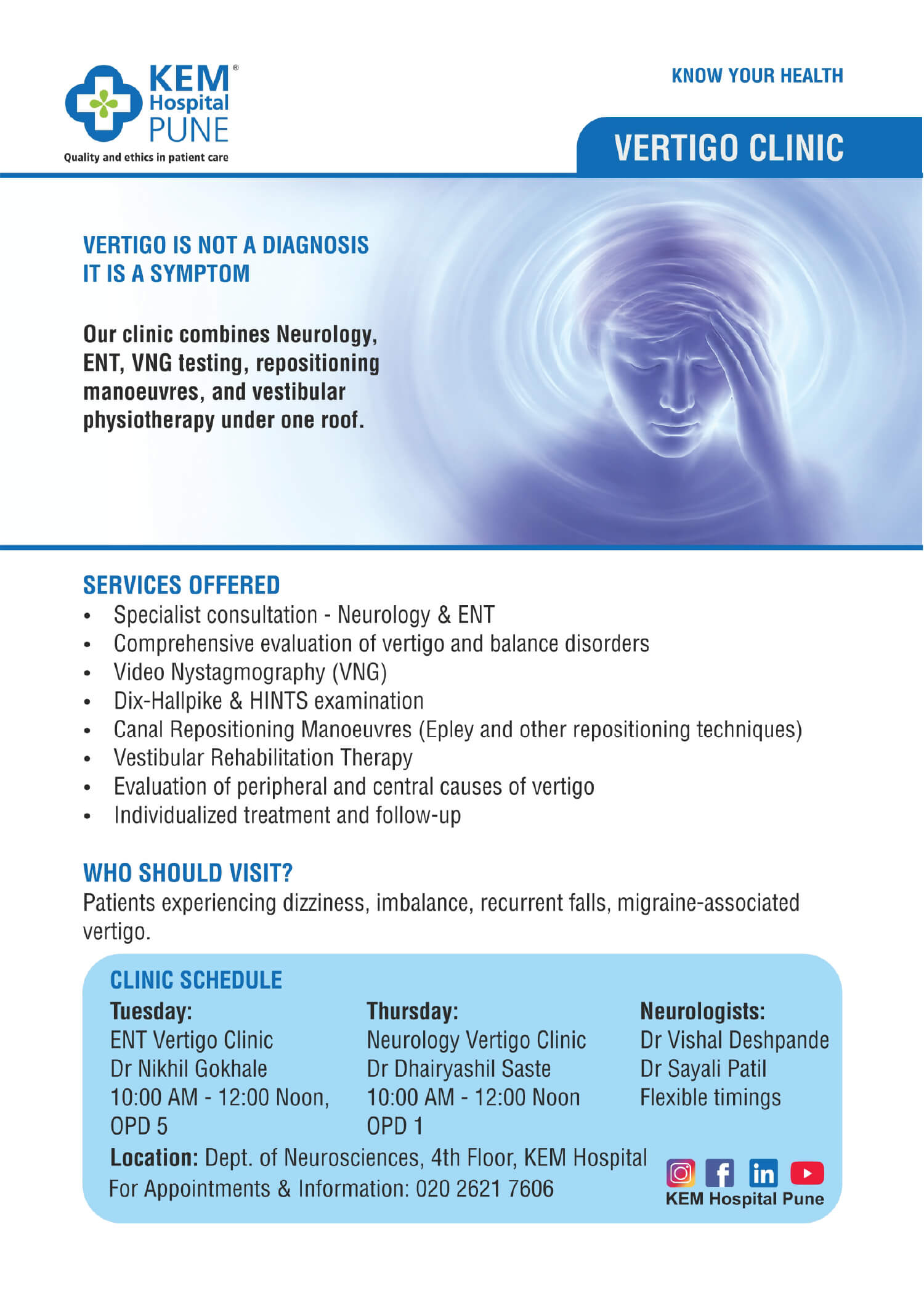
This clinic caters to the needs of patients suffering from vertigo and balance disorders, such as benign paroxysmal positional vertigo (BPPV), vestibular neuritis, vestibular migraine, Meniere’s
disease and brainstem and cerebellar disorders.
The clinic is supported with a Cyclops videonystagmography (VNG) machine. Patients undergo
a thorough neurological examination and a VNG test.
Nutrition and Dietetics
Oncology (Cancer Services) – Medical, Surgical & Radiation
Onco Surgery, Medical Oncology, Surgical Oncology, Radiation Oncology, Cancer Services, Day Care Centre